Using Your Own Cells to Heal Back Pain: Intradiscal PRP for Disc Pain in Midtown Manhattan
If a worn or degenerating disc in your lower back is causing your pain, you've probably been given a short list of options. You can live with it, keep getting steroid injections, or eventually consider surgery such as a spinal fusion or disc replacement. For many of the patients I see, that list feels less like a plan and more like a countdown.
I get it. When the pain comes from deep inside your spine, it's easy to feel you're running out of road. Surgery is intimidating, recovery can be long, and a full recovery is never promised. The steroid shots that helped at first may not last as long as they used to, and pain medication brings its own risks.
You deserve care that does more than mask the pain. Intradiscal platelet-rich plasma (PRP) is a regenerative medicine option that uses your body's own biology to calm inflammation and support healing in the disc, before you consider anything irreversible.
The Short Answer: What Is Intradiscal PRP?
Intradiscal PRP is a same-day, non-surgical procedure. A concentrated dose of your own platelets is injected directly into a painful spinal disc to reduce inflammation and support the disc's natural healing environment. It is used for discogenic low back pain and is most often considered for people with early-to-moderate degenerative disc disease who haven't found lasting relief from physical therapy, medication, or epidural steroid injections.
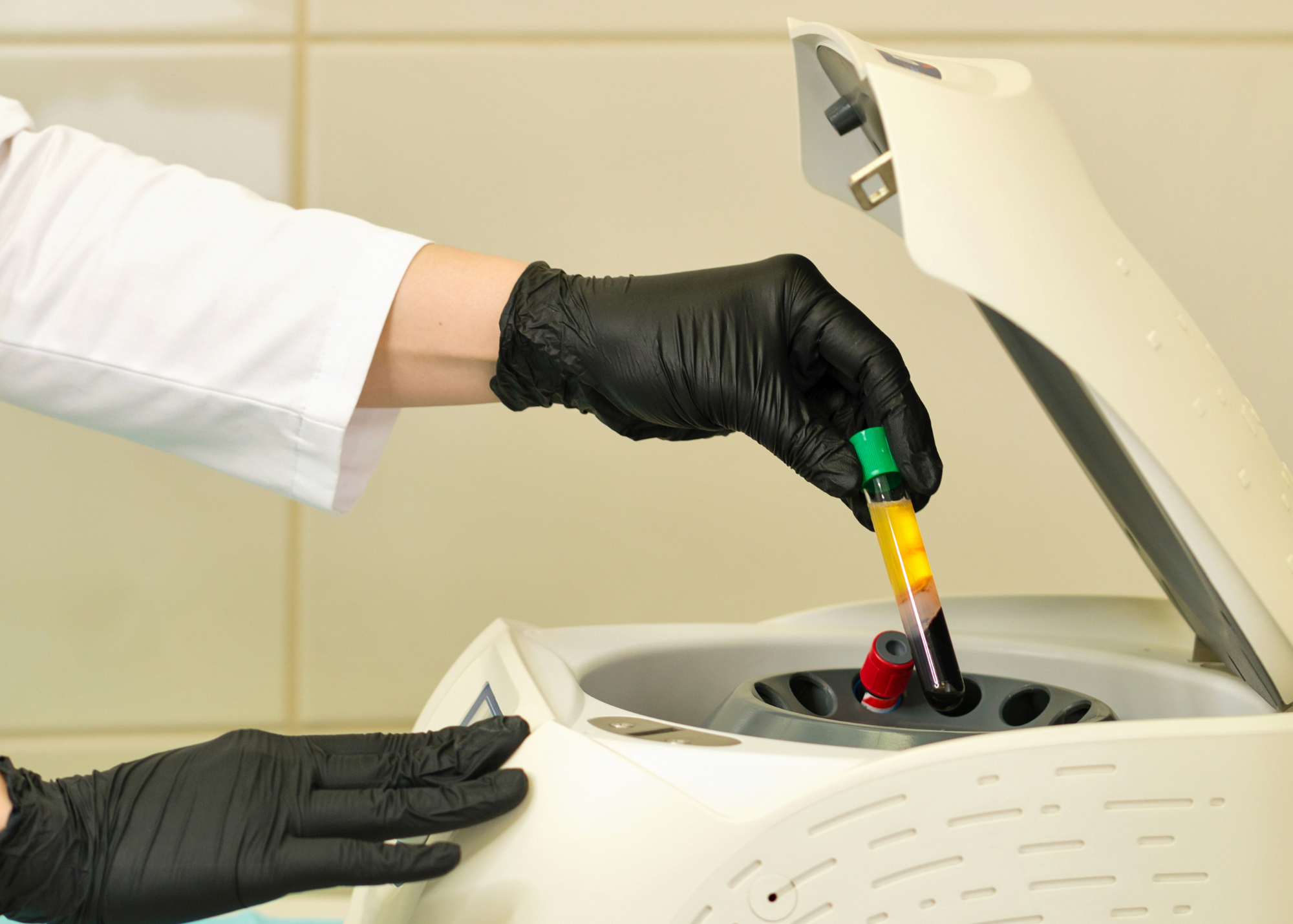
PRP is made from a small sample of your own blood, spun down to concentrate the platelets. Platelets carry growth factors that help direct tissue repair and reduce inflammation. When PRP goes directly into the painful disc, the aim is to improve the disc's environment rather than simply numb the pain (Pan et al., Scientific Reports, 2026).
Why I Offer Intradiscal PRP to My Patients in NYC
I've spent my career helping patients find non-surgical paths out of chronic pain. I offer intradiscal PRP to carefully selected patients because, for the right person, the results can be meaningful.
The research to date shows:
A landmark randomized controlled trial. In a double-blind, randomized controlled trial, patients who received intradiscal PRP improved significantly more in pain, function, and satisfaction than the control group, and many kept those gains for at least a year (Tuakli-Wosornu et al., as summarized in the ASPN Guideline, 2022).
Long-term durability. A follow-up of those same patients found that about 71% were still doing well 5 to 9 years later. A smaller group went on to have surgery (Cheng et al., as summarized in the ASPN Guideline, 2022).
Recent MRI-based results. A 2026 prospective study using advanced quantitative MRI found that roughly 79% of patients reached a meaningful improvement threshold at 6 months, with no treatment-related complications (Pan et al., Scientific Reports, 2026).
An Honest Word on the Evidence
Here’s my honest expert opinion: not every study has been positive. Some randomized trials found PRP no better than a placebo (saline) injection for disc pain. Expert reviewers currently describe intradiscal PRP as promising but still investigational, with results that vary from study to study (Zhang et al., European Spine Journal, 2026).
That's why I recommend this treatment selectively. Before we decide on it together, we'll talk through what the science does and doesn't prove yet, and whether your case fits the patients who have done best.
How Does Intradiscal PRP Work?
PRP delivers a concentrated dose of your own platelets and their growth factors, including PDGF, TGF-β, VEGF, and IGF-1, directly into the disc. In laboratory and animal studies, these growth factors:
Encourage disc cells to multiply
Support the disc's structural matrix
Reduce apoptosis (cell death) within the disc
Turn down the inflammatory signals that drive pain
(Pan et al., Scientific Reports, 2026)
The goal is to address the biology behind your pain, not just quiet the symptoms. That root-cause approach guides everything I do in my practice.
What Happens During the Procedure?
Intradiscal PRP is an outpatient, needle-based procedure performed in the office:
A small blood draw. We take a sample of your blood and process it to concentrate the platelets.
Precise, image-guided placement. Using live X-ray (fluoroscopic) guidance, I inject the PRP precisely into the disc identified as your pain source.
Home the same day. The whole visit usually takes about an hour, including preparation.
There's no incision, no hardware, and no hospital stay.
Is Intradiscal PRP Safe?
PRP is generally low-risk because it comes from your own blood, so allergic or rejection reactions aren't a concern.
The most significant risk is discitis, an infection of the spinal disc. It is uncommon, with an infection risk of less than 0.1%. I use meticulous sterile technique and, when appropriate, preventive antibiotics to keep that risk as low as possible (Zhang et al., European Spine Journal, 2026; Zhang et al., BioMed Research International, 2022).
You may have temporary soreness at the injection site or a short-lived increase in back pain. Across the pooled published studies, significant adverse events have been rare (Peng et al., Medicine, 2023).
How Long Does Intradiscal PRP Take to Work?
PRP is usually slow to start working, but its effects can last a long time. Unlike a steroid shot, it isn't designed for instant relief. It works by helping your body heal, and healing takes time.
The typical pattern:
First month: Pain and function often improve the most during this period.
3 to 6 months: Gains often keep building (Pan et al., Scientific Reports, 2026). Some trials found the advantage over other injections became clearest at around 6 months (Akeda et al., as summarized in Zhang et al., European Spine Journal, 2026).
1 year and beyond: When PRP works, relief can last a year or more, and for some patients, years (ASPN Guideline, 2022).
Intradiscal PRP vs. Spinal Fusion or Disc Replacement
In a surgery-first practice, ongoing disc pain often leads toward spinal fusion or artificial disc replacement. These are major operations involving hardware such as rods and screws, a longer recovery, and permanent changes to your spine.
Intradiscal PRP is a very different path:
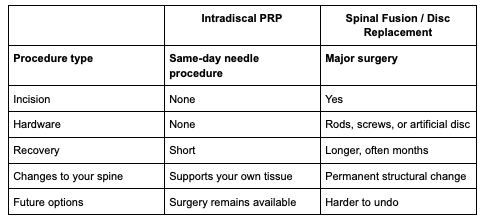
PRP doesn't burn a bridge. If you need surgery later, it's still an option. Trying PRP first lets you pursue a less invasive solution without giving anything up.
Who Is a Good Candidate for Intradiscal PRP?
The patients who tend to do best are (Serio et al., Current Pain and Headache Reports, 2025):
Active adults motivated to avoid or delay spinal surgery
People with early-to-moderate disc degeneration, not severe, collapsed, or multi-level disease
Those whose pain hasn't responded well to conservative care such as physical therapy, medication, and epidural steroid injections
Patients whose imaging or diagnostic workup points to the disc itself as the pain source
Many of my patients are busy professionals and athletes here in New York who can't afford months of surgical recovery. For them, a same-day procedure with a short recovery fits real life.
What Your MRI Can Tell Us
Because PRP targets pain coming from the disc, I carefully review your MRI for findings consistent with discogenic pain (Serio et al., Current Pain and Headache Reports, 2025):
Annular tears or fissures: a crack in the disc's tough outer ring
A "black disc": a disc that appears dark on MRI because it has lost hydration, a sign of a dried-out, degenerating disc
Mild-to-moderate loss of disc height
Patients with severe, multi-level degeneration or advanced structural collapse tend to respond less well. That's why a thorough review of your imaging comes before any recommendation (Serio et al., Current Pain and Headache Reports, 2025).
Diagnoses Intradiscal PRP May Help
If you've been given any of these labels, intradiscal PRP may be worth discussing:
Discogenic low back pain
Degenerative disc disease (DDD)
Internal disc disruption, annular tear, or annular fissure
"Black disc" or desiccated (dried-out) disc on MRI
Chronic, central low back pain from the disc that hasn't responded to conservative treatment
When PRP Isn't the Right Tool
PRP is aimed at pain from the disc itself, and not every back problem starts there. Spinal stenosis, facet joint arthritis, and nerve compression from a large herniation are treated differently. Pain from the vertebral endplates, often linked to Modic changes on MRI, may respond better to basivertebral nerve ablation (BVNA). Facet joint pain may be a better fit for radiofrequency ablation (RFA).
A misdiagnosis leads to the wrong treatment, so getting the diagnosis right is where every plan starts.
Supporting Your Discs with Lifestyle Medicine
As a Lifestyle Medicine physician, I don't see any single injection as the whole answer. Your discs depend on nutrients that diffuse in from nearby blood vessels, and that process is affected by your overall health: circulation, inflammation, activity level, sleep, and habits like smoking.
That's why your care plan may pair PRP with therapeutic exercise, anti-inflammatory nutrition, and other lifestyle changes that create the best possible environment for healing. You can read more about how diet shapes recovery in my post on [the gut-inflammation connection and PRP recovery].
What Does Intradiscal PRP Cost? Is It Covered by Insurance?
Many insurers still classify intradiscal PRP as a regenerative or investigational therapy, so it is often not covered and is usually an out-of-pocket expense. Cost depends on how many disc levels are treated and the details of your case.
During your consultation, my team will go over pricing and payment options clearly and up front. That way you can weigh the investment against alternatives like ongoing injections or surgery, with no surprises.
Your Path to a Pain-Free Back
If you're tired of a cycle of temporary fixes and worried that surgery is the only answer left, there's a clear path forward:
Schedule an appointment. Come to my office at 515 Madison Avenue in Midtown Manhattan. I'll take the time to understand your history, examine you, and review your imaging.
Develop your plan together. If you're a good candidate, your same-day outpatient PRP procedure can typically be scheduled within 1 to 2 weeks, as part of a personalized plan that addresses the root cause of your pain.
Live pain-free and optimize your healthspan. Get back to the work, training, and life you've been putting on hold, without the risks and long recovery of surgery.
Frequently Asked Questions
What is intradiscal PRP?
Intradiscal PRP is a non-surgical procedure in which platelet-rich plasma made from your own blood is injected directly into a painful spinal disc under X-ray guidance. It aims to reduce inflammation and support the disc's natural healing environment.
Is intradiscal PRP the same as a regular PRP injection?
It uses the same principle, your own concentrated platelets, but it is delivered inside the spinal disc with live X-ray guidance. It is a more specialized procedure than PRP injections into joints, tendons, or ligaments.
How long does it take for PRP to work on a disc?
PRP builds gradually. Many patients improve most during the first month, with continued gains over 3 to 6 months. When it works, relief can last a year or longer.
Can I still have surgery after intradiscal PRP?
Yes. Intradiscal PRP doesn't rule out surgery later. It is often used to avoid or delay surgery while keeping every option available.
Is intradiscal PRP covered by insurance?
It is often not covered, because many insurers still consider it investigational. My team reviews pricing and payment options with you up front during your consultation.
Will intradiscal PRP help sciatica from a herniated disc?
PRP targets pain coming from the disc itself. Nerve compression from a large herniation is usually treated differently, which is why a thorough evaluation and MRI review come first.
Where can I get intradiscal PRP in NYC?
I offer intradiscal PRP at my practice in Midtown Manhattan, 515 Madison Avenue, Floor 6, New York, NY 10022, as part of a personalized, non-surgical care plan.
This article is for general education and is not a substitute for an individualized medical evaluation. Whether intradiscal PRP is right for you depends on your history, examination, and imaging. Please schedule a consultation to discuss your specific situation.
References
ASPN Guideline, 2022 (summarizing Tuakli-Wosornu et al. and Cheng et al.)
Pan et al., Scientific Reports, 2026
Zhang et al., European Spine Journal, 2026 (including summary of Akeda et al.)
Zhang et al., BioMed Research International, 2022
Peng et al., Medicine, 2023
Serio et al., Current Pain and Headache Reports, 2025