The mild® Procedure in Midtown Manhattan: Relief for Leg Pain and Limited Walking from Lumbar Spinal Stenosis
If a walk to the corner, standing at the stove, or a trip through the grocery store leaves your lower back, buttocks, and legs aching, heavy, cramping, or burning, and leaning on a shopping cart or sitting down is the only thing that helps, I want you to know two things.
First, you are not imagining it. What you're feeling has a name. Second, major back surgery is not your only way out.
That pattern is often neurogenic claudication, a symptom of lumbar spinal stenosis, which is a narrowing of the spinal canal that puts pressure on the nerves heading to your pelvis and legs. It's one of the most common reasons older adults lose the ability to walk and stand comfortably. I see how quickly it shrinks a life: shorter walks, skipped trips, and saying no to the things you love.
I'm Dr. Evan Queler, a double board-certified physician in Physical Medicine & Rehabilitation and Lifestyle Medicine, fellowship-trained in interventional spine and pain management. At my Midtown Manhattan practice at Tru Whole Care, the mild® procedure is one of the ways I help the right patients get back on their feet without open back surgery.
What is the mild® procedure?
The mild® procedure (Minimally Invasive Lumbar Decompression) is an outpatient treatment for lumbar spinal stenosis. Working through an opening of about 5 mm, I remove small pieces of a thickened spinal ligament to relieve pressure on the nerves. It requires no general anesthesia, no implants, no stitches, and no overnight hospital stay.
Why I Offer mild® to the Right Patients
For years, spine care had a gap in the middle. On one side were repeated injections that offered temporary relief. On the other was open back surgery, with its relative risks, potential debility or long recovery. Many of my patients felt stuck between the two.
mild® fills that gap. It's more definitive than repeated injections, yet far less invasive than open surgery. And the evidence behind it is genuinely strong when applied definitively:
It outperformed epidural steroid injections. In the MiDAS ENCORE randomized trial, about 62% of patients treated with mild® had meaningful improvement in function (Oswestry Disability Index) at 6 months, compared with about 36% who received epidural steroid injections. Those gains held up through 2 years, and only about 6% of patients needed another operation over that period (Cox et al., Current Pain and Headache Reports, 2026; Staats et al., Regional Anesthesia and Pain Medicine, 2018).
It helped patients walk farther. In the MOTION randomized trial, patients who had mild® plus standard care had greater improvements in pain, disability, and objectively measured walking tolerance than those on standard care alone, with benefits sustained through 3 years (Cox et al., 2026).
Real-world results match the trials. In a review of 300 patients, pain scores dropped significantly, improvement often began within 2 weeks, the biggest gains occurred within the first 3 months, and no serious adverse events were reported (Zhang et al., Pain Physician, 2026).

How the mild® Procedure Works
What happens during the mild® procedure?
In many people with stenosis, the main source of the squeeze is a thickened, overgrown ligament inside the spinal canal called the ligamentum flavum. Think of it as a rubber band that has gotten thicker over the years and started crowding the nerves.
During mild®, I use live X-ray guidance (fluoroscopy) to work through a tiny opening about the size of a pencil eraser (roughly 5 mm). Specialized instruments remove small pieces of the overgrown ligament, along with a sliver of bone, to restore space around the compressed nerves. Contrast dye confirms that the canal has been opened up.
Because nothing is implanted and the stabilizing bones and joints of your spine are left intact, your future options stay fully open, including surgery if it were ever needed (Cox et al., 2026).
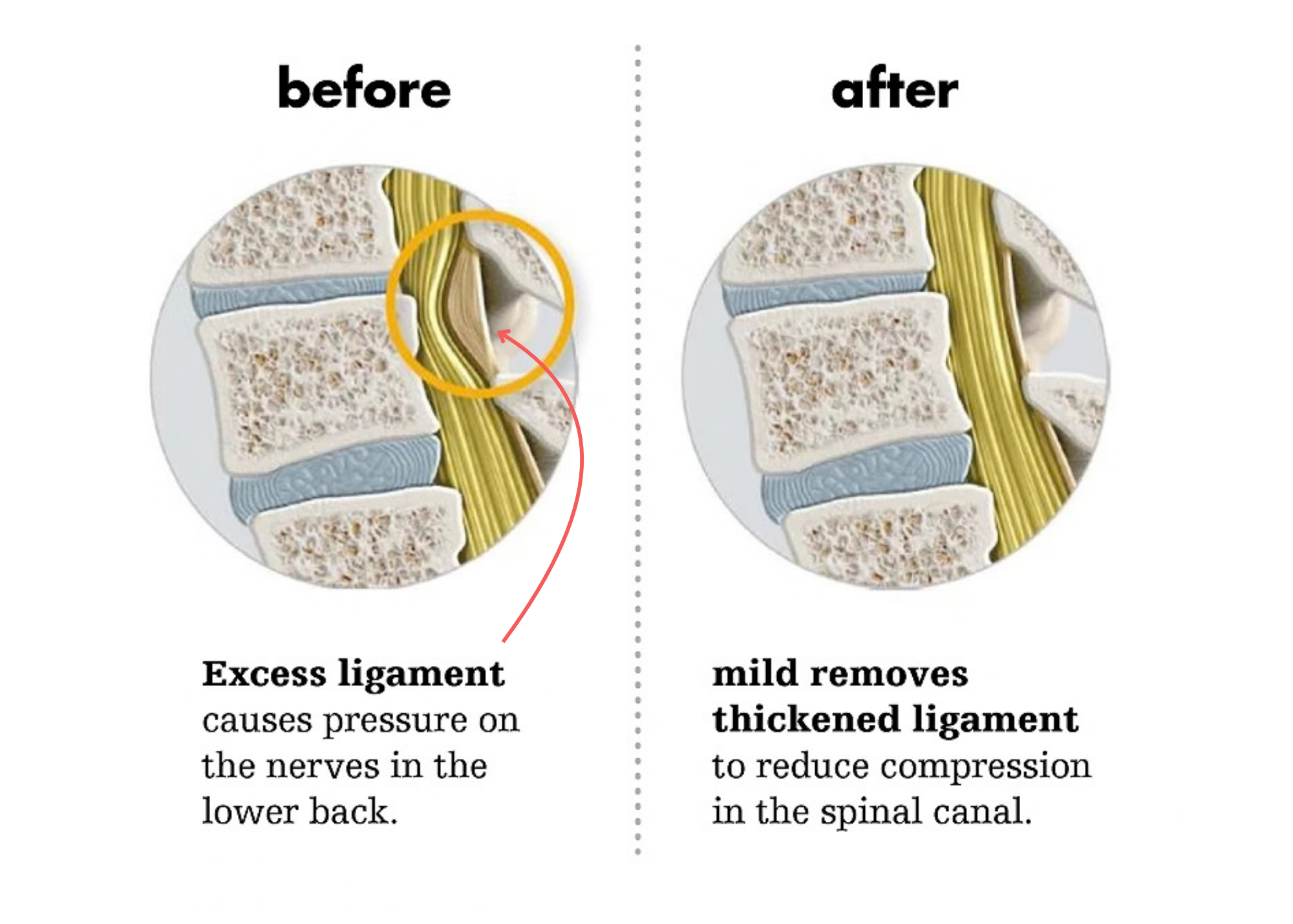
Original image owned by Stryker
Is the mild® procedure safe?
Every procedure carries some risk, and I'll always walk you through yours honestly. That said, mild® has a favorable safety record. In randomized trials, serious procedure-related complications were rare (about 1.3% device- or procedure-related adverse events, with no serious events in the 2-year MiDAS ENCORE follow-up) (Staats et al., 2018; Cox et al., 2026). In a real-world series of 95 patients, there were no complications during the procedure, and about 97% had no complications afterward. The few that did occur were minor and temporary, such as bruising, nausea, dizziness, or brief numbness (Boussy et al., Pain Physician, 2026).
To be complete: one propensity-matched comparison found a higher rate of postoperative neurologic symptoms after mild® than after open decompression, although overall complication rates between the two were similar (Cox et al., 2026). Some patients notice temporary tingling or numbness after the procedure. That's one reason careful follow-up is built into every care plan I create.
What results can you expect, and how soon?
Most patients can expect:
Less leg and back pain
The ability to walk farther
The ability to stand longer
Relief often starts early. Improvement has been reported as soon as 2 weeks, with the biggest gains in the first 3 months and benefits shown to last through 2 to 3 years in clinical trials (Zhang et al., 2026; Cox et al., 2026).
One important note: mild® targets pain and walking limitations caused by pinched nerves. It isn't designed for isolated low back pain without leg symptoms. That's exactly why getting the right diagnosis first matters so much.
mild® vs. traditional back surgery
When spinal stenosis hasn't improved with conservative care, the usual next step in a surgery-first practice is a laminectomy. That can mean traditional open surgery or, in some cases, a minimally invasive surgical approach through small incisions, which many surgeons now prefer when it's an option. Either way, a laminectomy removes part of the lamina, the bony section at the back of each vertebra that forms the roof of the spinal canal and anchors a ligament called the ligamentum flavum. Taking away that bone can make the spine less stable. When that happens, one vertebra can slip forward over the one below it, which can narrow the canal again and may eventually lead to a spinal fusion, a larger surgery that uses screws and rods to hold the vertebrae in place. In general, the more invasive the surgery, the more muscle is cut or pulled aside, the more bone is removed, and the more blood loss, hospital time, and rehabilitation you can expect (Kartal et al., Scientific Reports, 2025).
mild® (minimally invasive lumbar decompression) takes a different route. Guided by real-time imaging and working through a tiny opening in the lower back, the physician removes small pieces of the thickened ligament and bone that are crowding your nerves. There's no cutting through the back muscles, no large-scale bone removal, and no hardware left behind. It's done as an outpatient procedure, so most people go home the same day. Compared with open surgery, minimally invasive decompression is associated with shorter procedure times, less blood loss, and a faster recovery (Kartal et al., 2025; Cox et al., 2026).
To give you the full picture: some minimally invasive surgical approaches also have very low complication rates, and open surgery is still the more thorough option when the narrowing is severe and caused mostly by bone. No single procedure is right for everyone. As a double board-certified physiatrist with fellowship training in interventional spine and pain management, I take the time to find out what's actually causing your symptoms before recommending anything, so your plan fits your spine and your life.
How long does the mild® procedure take, and how soon can you schedule it?
The procedure itself is short. It's typically done with local anesthesia and light sedation, and most patients go home the same day and return to normal activity within about 24 hours (Cox et al., 2026).
Once I've examined you and reviewed an MRI that shows the right findings, mild® can usually be scheduled promptly. There's no long surgical work-up and no lengthy hospital pre-admission process.
Who Is a Good Candidate for the mild® procedure?
The ideal candidate is usually an adult who:
Has had leg and back symptoms for at least 3 months
Feels pain or heaviness in the legs with walking and standing that eases with sitting or bending forward
Has an MRI showing a thickened ligamentum flavum (typically ≥ 2.5 mm) narrowing the spinal canal
Hasn't found lasting relief from physical therapy, medications, or injections
(Cox et al., 2026)
mild® is an especially good option for older patients or those with other health conditions who are considered higher-risk for open surgery, since it avoids general anesthesia and major tissue disruption (Boussy et al., 2026; Zhang et al., 2026).
It may be worth talking with me about mild® if you've been told you have:
Lumbar spinal stenosis (spinal canal narrowing)
Neurogenic claudication (leg or buttock pain, cramping, or heaviness with walking and standing)
Ligamentum flavum hypertrophy (a thickened spinal ligament)
Central canal stenosis, with or without lateral recess narrowing
Degenerative (age-related) changes of the lumbar spine, including multilevel disc degeneration causing soft-tissue narrowing
Mild degenerative spondylolisthesis (up to grade 2) in selected patients
mild® is generally not the right fit if your main problem is low back pain without leg symptoms, significant spinal instability, higher-grade slippage, major nerve weakness or deficits, or narrowing caused mostly by disc herniations and/or bone spurs rather than a thickened ligamentum flavum (Cox et al., 2026). An in-person evaluation and a careful review of your MRI are the gold standard way to know for sure.
What Happens If You Keep Waiting?
I understand why so many people put this off. When you've been told your only real option is surgery, it's natural to push through, sit down more often, and hope it settles on its own.
If your symptoms have not responded to conservative care, such as relative rest and a tincture of time, don’t put yourself on the shelf!
There are proven safe and effective treatment options that can help you alleviate pain and heal.
You deserve better than what some have shared of their prior experiences: feeling unheard, inadequately informed of options and risks, and rushed to make decisions.
You deserve an honest look at every option, and a doctor who takes the time to understand what's really driving your pain.
A Note on Cost and Insurance
Coverage varies by insurer and plan, so the most reliable step is to have my office verify your specific benefits before scheduling. After an office visit, we can make an informed decision of all of your options, including whether the mild® procedure is right for you.
It's also worth knowing that mild® has been studied from a value standpoint. In a Medicare-perspective cost-effectiveness analysis, mild® was the most cost-effective of three options over 2 years ($43,760/QALY), ahead of repeated epidural steroid injections, with open laminectomy the least cost-effective ($125,985/QALY) (Udeh et al., Pain Practice, 2015). In other words, the less invasive path can be easier on your body and a sound financial choice.
Your Path to Walking Comfortably Again
As a Lifestyle Medicine Interventional Physiatrist, I don't look at your spine in isolation. If mild® is right for you, it becomes one part of a plan built around your whole life, which may also include therapeutic exercise and lifestyle strategies that help keep your spine healthy for the long run.
Here's how we get started:
Schedule an appointment. Come to my Midtown Manhattan office at 515 Madison Avenue and tell me what you've been going through.
Develop your plan together. I'll examine you, review your imaging, and give you an honest opinion on whether mild® or another non-surgical option makes the most sense.
Live pain-free and optimize your health span. Get back to the walks, the travel, and the everyday moments that pain has been taking from you.
Frequently Asked Questions About the mild® Procedure
-
mild® is a minimally invasive procedure, not open surgery. It's done through an opening of about 5 mm with local anesthesia and light sedation, uses no implants or stitches, and doesn't require an overnight hospital stay.
-
Most patients go home the same day and return to normal activity within about 24 hours. Improvement in leg pain and walking has been reported as soon as 2 weeks, with the biggest gains in the first 3 months.
-
Clinical trials have shown that benefits hold up through 2 to 3 years, and only about 6% of patients in the MiDAS ENCORE trial needed another operation during the 2-year follow-up.
-
In a randomized trial, about 62% of patients treated with mild® had meaningful improvement in function at 6 months, compared with about 36% of those who received epidural steroid injections. Injections can still be helpful for some patients, which is why the right choice depends on your individual evaluation.
-
Generally, no. mild® is designed for leg and buttock pain, heaviness, or cramping caused by nerve compression from spinal stenosis. Isolated low back pain usually calls for a different approach.
-
Dr. Evan Queler evaluates patients for mild® at his practice at Tru Whole Care, 515 Madison Avenue in Midtown Manhattan. An in-person exam and MRI review determine whether you're a good candidate.
This article is for general education and is not a substitute for an individual medical evaluation. Whether mild® is right for you depends on your symptoms, exam, and imaging.
References
Cox R, et al. Effectiveness and Safety of the Minimally Invasive Lumbar Decompression (MILD) Procedure for Adults with Lumbar Spinal Stenosis: A Systematic Review. Current Pain and Headache Reports, 2026.
Staats PS, et al. Long-Term Safety and Efficacy of Minimally Invasive Lumbar Decompression: 2-Year Results of MiDAS ENCORE. Regional Anesthesia and Pain Medicine, 2018.
Zhang C, et al. Retrospective Review of the Outcomes of 300 Minimally Invasive Lumbar Decompression® Cases. Pain Physician, 2026.
Boussy C, et al. Retrospective Evaluation of Minimally Invasive Lumbar Decompression (Mild®) for Neurogenic Claudication: A One-Year Follow-Up Study. Pain Physician, 2026.
Kartal A, et al. Minimally Invasive Tubular Decompression Versus Traditional Open Surgery for Lumbar Spinal Stenosis: A Systematic Review and Meta-Analysis. Scientific Reports, 2025.
Udeh BL, et al. The 2-Year Cost-Effectiveness of 3 Options to Treat Lumbar Spinal Stenosis Patients. Pain Practice, 2015.